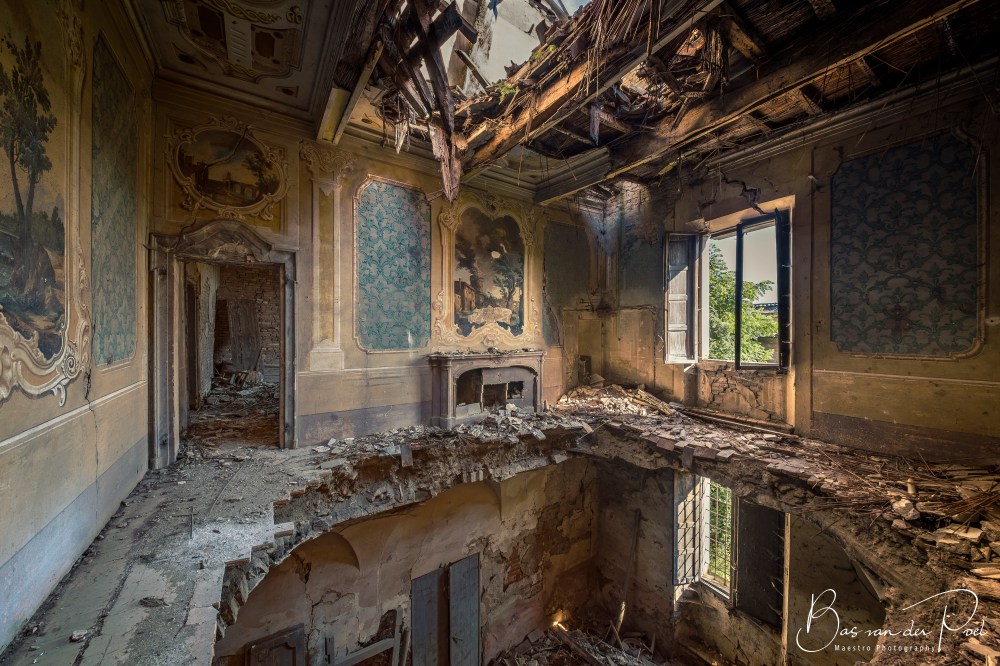
An international photo trend has photographers visiting old and abandoned mansions – so that “the general public” will know about their cultural heritage.
Urbex photos by: Bas van der Poel – Maestro Photography – www.maestro-photography.nl
Written by: Benedicte Hilde Tandsæther-Andersen
Italy, Tuscany. The autumn sun rises above a green landscape, providing warmth to cold vines. There are only a matter of days before the first snow will come, but until then, the sun can spread its morning glow on a fertile landscape. An old wine farm – with vineyards reaching across a hillside – answers the early morning light with nothing but silence. In its heyday — almost 100 years ago — the farm was honouring the ancient wine god, Bacchus. Today, bare and dying fruit trees stand bravely in the courtyard — and in the mansion’s cold bedrooms, no one wakes up to the cautious sunbeams. Only deafening silence awaits the morning light, as it peaks through the dusty windows.
Decaying buildings are a growing problem in Italy, but over the past decade, a certain melancholic and romantic perception of these buildings has led to the emergence of a new photo trend. Photographers visit abandoned mansions, train stations and theaters, and photograph them. These vacant buildings are documented for eternity, and the images are shared on social media: Facebook, Instagram and other communities get to see the state of decay — but a few photographers have also published photo books. The pictures show grandiose and heavily decorated rooms, now fading and collapsing from their former glory. There are often beautiful dining rooms, wide marble staircases and ceiling paintings – all marked by time and gravity. The photos show beautiful Italian frescoes crumbled to nothing, lying like dust among the wine barrels the frescoes hit when the 300-year-old roof collapsed. The photographers believe that by doing “urbex”, an abbreviation for urban exploration, they can preserve some of the cultural heritage before it disappears.
History for trouble
With its remarkable history, Italy has gained a responsibility that is both a blessing and a curse. It is hardly possible to plan a swimming pool, a primary school or a shopping center without discovering a Roman bath house or several layers of antique villas below the ground. Centuries-old history rests just below the surface, no matter where you stick a spade in the ground. Every building project comes with a risk: the person who chooses to to pick up a spade, must also take responsibility for what there is to find. Construction work is often stopped for several years after discovering the presence of Ancient Rome. And as it turns out, the newer history is neglected due to focus on the older and more remarkable events. So with the financial changes and other challenges in Italy, not every Italian citizen is dreaming of inheriting a manor. To those who inherit such a structure, however, this can also be a curse they would rather give away — to an urbex photographer, for example.
Another curse the Italians are barraged with, is the relatively frequent occurrence of earthquakes. The very first recorded earthquake hit Pompeii on February 5, in year 62. The last recorded earthquake when this was written, happened on October 6, 2018, in Sicily. Almost three years ago, the Marche area in Italy was hit by one of the strongest earthquakes recorded in Italy in recent times, measuring 6.2 on the Richter scale. 299 people died, and more than 400 were injured. Four years earlier – in 2013 – Tuscany, one of the world’s most renowned wine areas, was hit by a 5.2-magnitude earthquake. The ruins from each earthquake have only been partially cleared up: A car crushed by building material the size of a boulder is still causing a dramatic effect in the driveway of a wine mansion, and testifies to the event that led to this house being abandoned today.
(The article continues below the photo.)
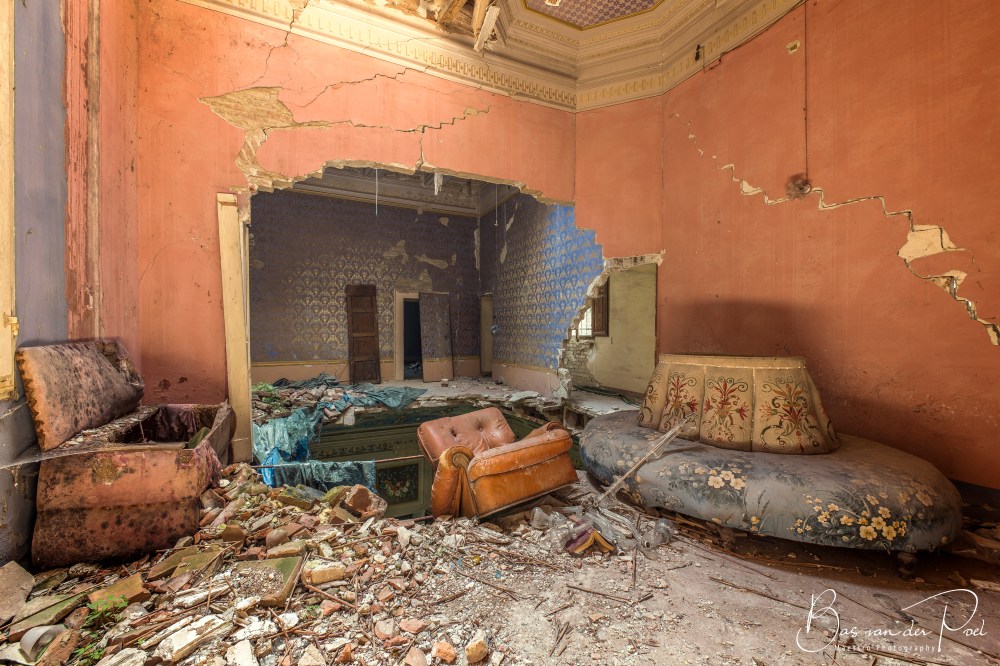
Photo by: Bas van der Poel – Maestro Photography – www.maestro-photography.nl
Preserving for posterity
Unesco defines the term “cultural heritage” as: mobile cultural heritage (paintings, statues, money, etc.), non-mobile cultural heritage (monuments, archaeological sites, etc.), underwater cultural heritage (shipwrecks, underwater ruins and towns), as well as language, artistic practices and rituals. Thus, the old Italian vineyards and their farms fit into the first two categories, but lack the authorities’ recognition as historically invaluable buildings. The goal of the urbex photographers is that the buildings – once inaccessible to the public, those who did not belong to the nobility – should be made into something that the population can relate to. What is cultural heritage, and why should it be preserved?
Urbex photographer Bas van der Poel, who runs the Facebook page Maestro Photography, talks about what he describes as his “hidden treasures” and how he developed an interest in old and decaying buildings:
— I started this way of photographing 10 years ago. When i was doing a modelshoot in an old abandoned factory. During the shoot and waiting in between, i noticed i was more fascinated by the building and less by the model. The lines of the building, the beauty of the decay, the colors of rust. That’s how it all started, van der Poel says in a Facebook message.
He views the abandoned places as hidden treasures, and photographs them in an attempt to preserve them for posterity.
— With my pictures i try to show the world what beauties are hidden behind these long forgotten doors. For me the most important thing is to show these places in a way as if you were there yourself. To capture just that feeling in these images is the hardest thing to do. These locations are hidden treasures for me… For me it is a kind of final tribute to the locations. Before they disappear forever.
(The article continues below the photo.)
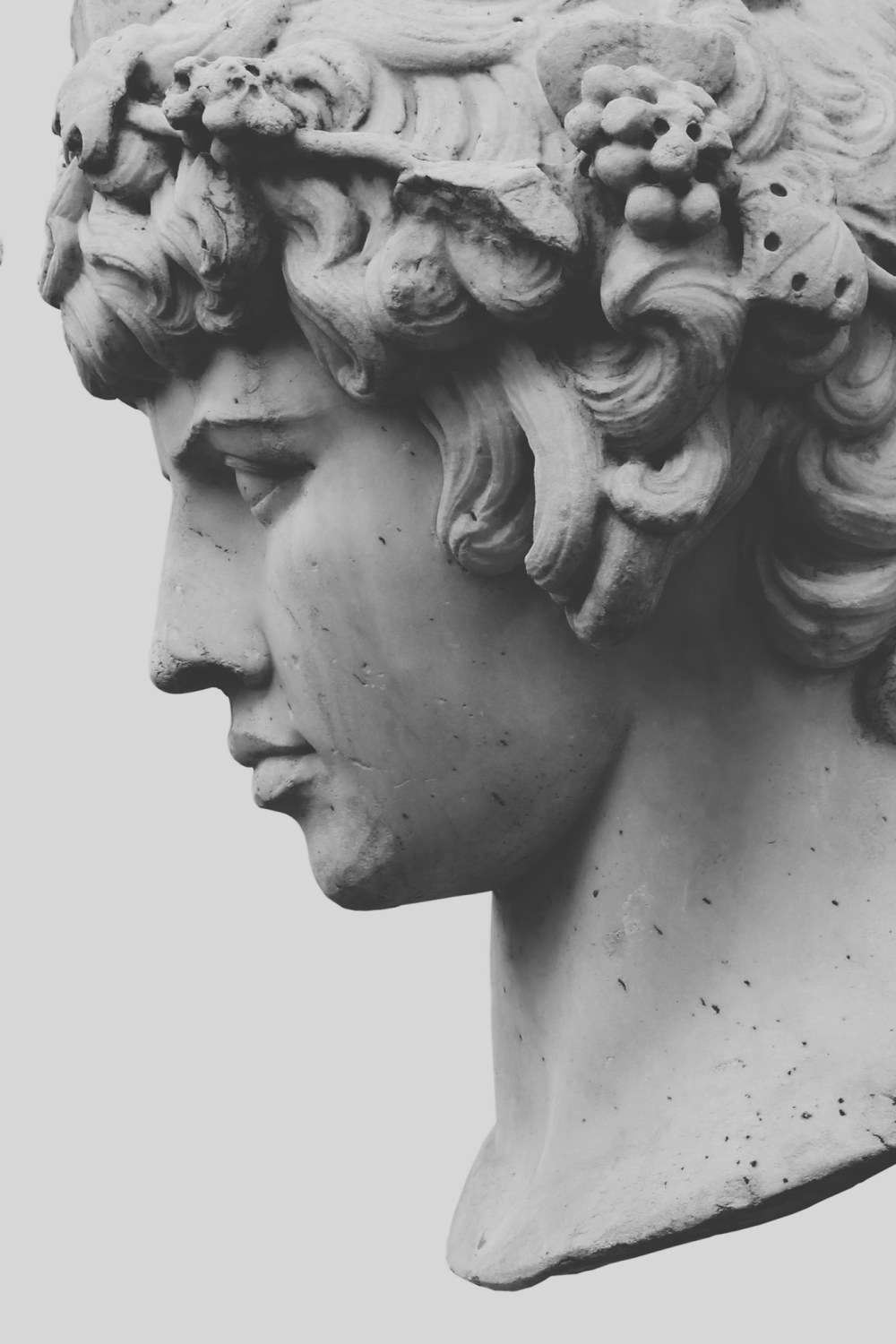
Old bust depicting Bacchus. Photos: gors4730. Adobe Stock. Creative edit of original.
The public’s mansion
Urbex photography and tourism have in recent years become such popular activities that there are several Youtube videos of people exploring dilapidated wine farms, theaters and other buildings. Teenage Urbexers count wine bottles stacked in hallways adorned with mirrors and angel frescoes, but nobody ever bring any bottles home. In the “codex” of Urbex photography, there are certain guidelines: For example, it is forbidden to disclose where the buildings are located geographically. And as part of not revealing where the wine farms are, they are given nicknames. Palazzo Teresa e Luigia, Villa Margherita, Sbertoli Villa – all villas or wine mansions – and nicknames that have more or less replaced the original names of the buildings. But despite the total decay that has hit several of the once extravagant villas and palaces, in many cases there are still some who care about them. Several Urbex photographers can tell stories about when they had to escape after hearing warning shots fired by local farmers. The fear that these houses will be looted is linked to the aforementioned rule of Urbex photography: It is not allowed to bring anything home, nothing but what has been captured on camera. Theft is considered to be a crime as serious as burglary in inhabited houses.
Bacchus’ last winter
The Greek legend of the wine god Bacchus tells of his death and resurrection. It is always the same, and in cycle with the seasons. Spring means his birth, and winter means his death. The cycle repeats itself without diversion, even on an abandoned vineyard where the grapes sometimes still find a chance for survival — until the inevitable autumn.
The rays of the rising autumn sun shine through a gaping hole in the mansion’s roof. Heavy rainfall has made the ceiling too heavy for its own weight, and the result is a collapse through several floors. Building materials hang in clusters from ceiling frescoes where angels and ancient gods point to a hole where there once was a centerpiece — the most noticeable artwork of the ceiling. And in the dining room, the floor is slowly, but surely releasing bricks from the construction — allowing them to land among the rubble of the basement.
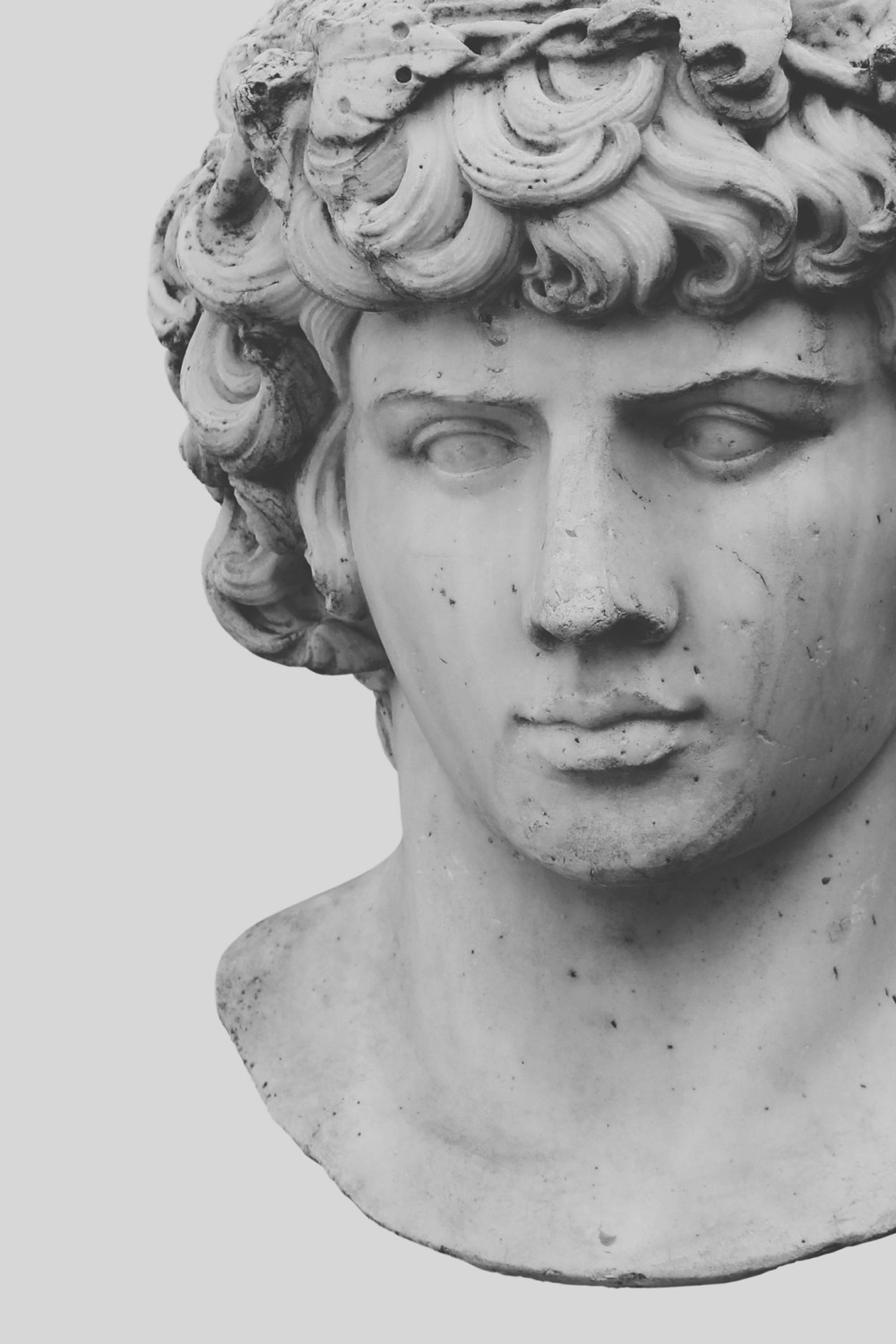
Old bust depicting Bacchus. Photos: gors4730. Adobe Stock. Creative edit of original.
 Chamber of Stories and Myths